
OpenStay : A Digital Storefront for Every Property

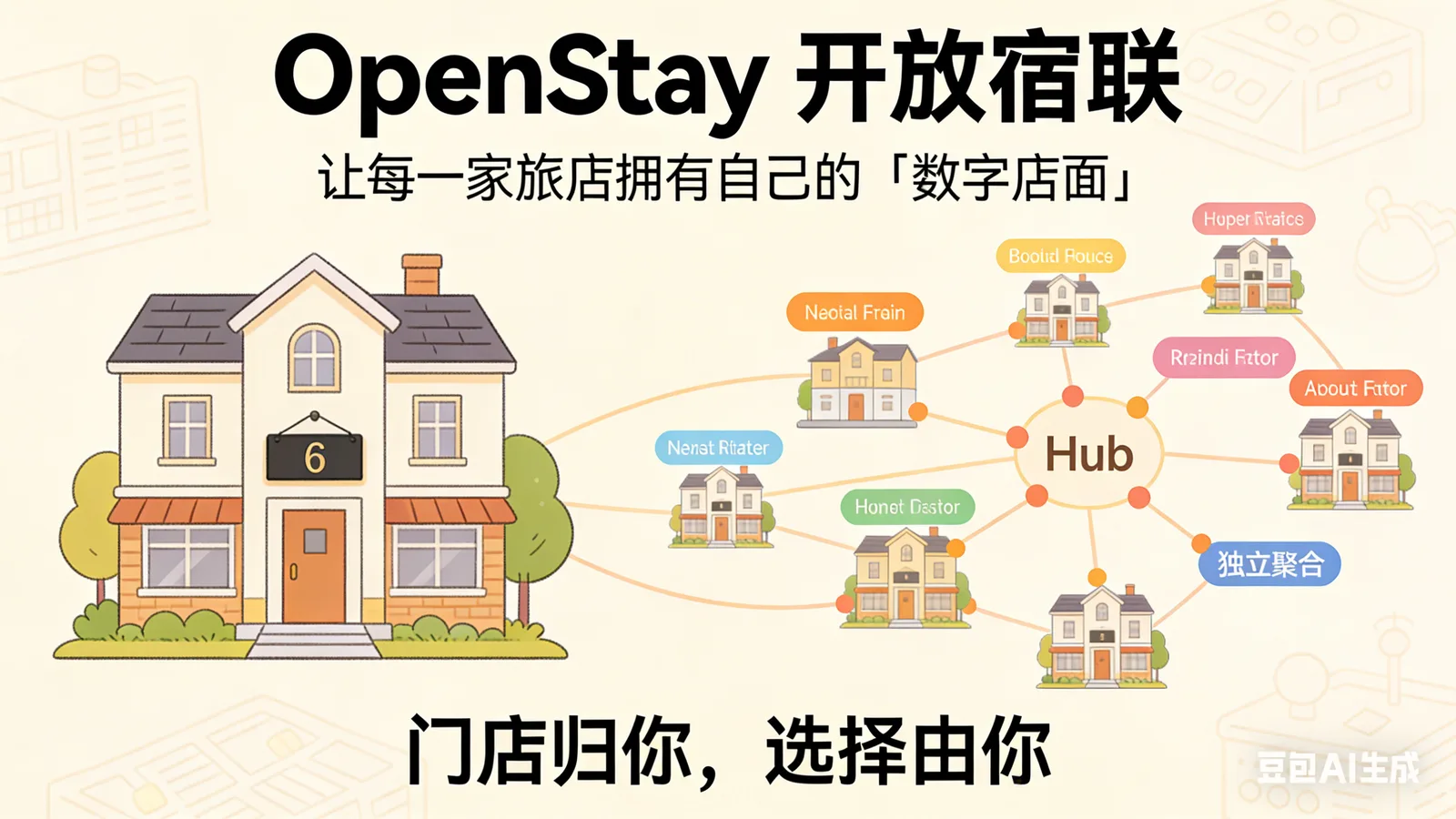
What this is: A community discussion draft. It invites feedback and co-design; it is not a committed product roadmap from any company. Version: 1.0 (standalone reading edition) Date: March 2026
Who this is for
Hotel, guesthouse, and B&B owners, travel enthusiasts, founders building regional travel platforms, and anyone asking whether hospitality can escape dependence on a handful of global gatekeepers.
You do not need to know how to code or any particular open-source project. A few technical terms appear only where we explain them in plain language.
The idea in three sentences
- Every hotel, inn, guesthouse, or homestay can have a booking site and guest relationships that truly belong to them, instead of living entirely inside one global app.
- Many such independent properties can choose to join different aggregators (we call them Hubs). A Hub helps you get discovered, can vet credentials, and earns revenue through subscriptions and/or a share of bookings—at terms you negotiate or pick from tiers.
- Travelers can pick a Hub they trust, the way they pick a TV channel, to browse and book; if they already know your property, they can open your page directly with no middleman—no third party has vetted that path, so guests judge risk themselves.
We want this model to grow worldwide with open rules, many participants, dignity for single properties, and replaceable middle layers.
Why another way of thinking helps
Today most people book stays through a small set of large online travel agencies (OTAs). They made search easy, but they also create familiar pain:
- High commissions: Small and mid-size properties lose a large slice of margin; they have little leverage.
- Weaker brand: Guests remember the platform, not necessarily your name or story.
- Data you don’t control: Listings, photos, reviews, and guest relationships often sit with the platform; switching channels is painful.
- Hard-to-read trust: Fake reviews and misleading photos make it unclear whether “the platform vouches for this” or “the host is on their own.”
- Rules differ by country: Licenses, short-term rental law, and tax vary. One global app trying to rule everything is often too rigid—or too slow on local compliance.
OpenStay is not claiming to replace incumbents overnight. It is a structural complement: more choice for properties, aggregators, and travelers.
What OpenStay is: a simple picture
Picture a shopping street:
- Your property = a standalone shop with your sign, your look, your prices, and your checkout. Guests deal with you directly.
- A Hub = a mall or visitor center. It showcases many properties, offers guided browsing, and may run entry checks (credential review). The mall charges rent or takes a cut of sales.
- The traveler = someone walking the street. They can enter the mall (pick a Hub, compare and filter inside) or walk straight into one street-front shop (only that property’s site).
OpenStay’s stance: the storefront stays yours; there can be many malls, and you can join several or none—not one mall for the whole planet.
Four core roles
| Role | Who they might be | What they care about most |
|---|---|---|
| Property | Hotels, chain outlets, B&Bs, hostels | Own brand, fair fees, multi-channel reach, guest relationships at home |
| Hub operator | Local associations, startups, vertical influencers, corporate travel services | Quality of onboarding, distinctive curation, steady revenue (subscription + rev share, etc.) |
| Traveler | Leisure and business guests | Easy discovery, booking, changes/cancellations, trustworthy info, clear recourse |
| Ecosystem partners | Developers, payment providers, design shops | Themes, plug-ins, compliance tooling, analytics (with privacy) |
What properties get (the single-property “digital storefront”)
Below is a discussion backlog from simpler to harder; shipping can be phased.
Presence and brand
- Your own booking experience (look and feel, multiple languages), like a real website—not lost in a one-size-fits-all template.
- Room types: size, bed layout, max guests, amenities (Wi‑Fi, AC, parking, etc.).
- Strong photos and optional short video; encouraging source credits reduces disputes.
Inventory and pricing
- Calendar: which nights are open, maintenance blocks, peak pricing.
- Rules: weekend rates, holidays, minimum stay, cancellation policy (flexible / moderate / strict).
Orders and communication
- Guest picks room type and dates, enters guest details, accepts policies, then gets an order.
- Host accepts or declines, logs negotiated changes, handles refund requests.
- Reminders by email, SMS, etc. (exact channels depend on implementation phase).
Trust signals (can pair with a Hub)
- How licenses or permits are shown must follow local law; “verifiable records” are one possible direction—details for legal and product co-design.
- The site can list which Hubs include you so guests see who did extra review.
What Hubs get (aggregation and review)
A Hub is not “another monopoly platform” but a competing service: travelers can switch Hubs; properties can switch Hubs or join several (where rules allow).
Onboarding and review
- When a property applies, the Hub can request documents and run human or assisted checks (spot checks, deny lists, etc.).
- Only approved listings enter the recommended catalog; rejections or violations lead to delisting, with an appeals path.
- Tiers (e.g. basic / advanced): higher tiers might mean more exposure, faster sync, better placements—and different fees.
Discovery and search
- Combine approved properties into a searchable directory: destination, dates, price band, amenities, tags (family-friendly, pet-friendly, etc.).
- Detail pages might be summary + hand off to the property to complete booking, or booking inside the Hub—these differ in legal role and commission and should be phased and debated with the community.
Revenue (mix and match)
- Subscription: the property pays to stay listed, indexed, and promoted.
- Revenue share: a cut of bookings attributed to the Hub.
- Value-add: placements, operations support, multilingual packaging, anonymized market insights.
Risk and governance
- Reporting, investigation, delisting, and appeals must be clear and auditable.
- For direct links to a property without going through the Hub, the Hub should state clearly: that path was not reviewed by this Hub; we do not vouch for accuracy.
What travelers get
Two ways to browse
- Curated path (like entering a mall) Pick a Hub you trust (e.g. focused on one country, one stay type, or one language community). Search, filter, and compare. Listings are usually reviewed by that Hub—more peace of mind, not a legal guarantee—see each Hub’s published rules.
- Direct path (like a friend’s recommendation) You already have a link or QR code to one property. No third party filtered it for you; the page should show a clear notice; you decide whether to trust that host.
Basic journey
Discover → details → book → manage orders → review after stay.
Logging in with a digital wallet–style identity can give you a portable profile across properties (fewer one-off accounts) and room to reduce fake reviews—depth can grow over phases.
Compared with “traditional big platforms” (plain language)
| Topic | Typical large OTAs | OpenStay concept |
|---|---|---|
| Who sets the rules | Often one global rulebook | Many Hubs compete; rules can differ; properties can move |
| Your brand | Easy to become “one listing among many” | Your name and story stay central |
| Data and relationships | Often with the platform | Anchored on the property’s own system for long-term ops |
| Commission pressure | Little negotiating power | Hubs are replaceable; fees can be tiered and negotiated |
| Global vs local | One product worldwide, compliance lag | Regional Hubs handle local rules while staying interoperable |
| Innovation | Waits on platform roadmaps | Single properties can experiment: loyalty, bundles, local experiences |
“Disruptive” here does not mean deleting middlemen overnight. It means middlemen are no longer singular, and data and brand are not locked in one black box—room for healthier market structure.
Technical foundation (minimum jargon)
OpenStay builds on ideas such as ArcBlock Blocklets: each property and each Hub can run as a small app you deploy and operate yourself—digital storefronts and digital malls—connected by open conventions instead of everyone sharing one opaque backend.
In everyday terms:
- Verifiable identity: operators can prove which organization is acting, reducing impersonation.
- Public directory (optional): Hubs and properties that opt in can appear in a globally discoverable list—like a phone book with signals of who has staked credibility so users know where to look first. (Engineering details are for the community to design.)
- Delegated billing: properties authorize a Hub to collect subscription or share revenue under rules fixed up front, reducing disputes.
You don’t need to remember the labels—only that the goal is transparency, portability, and many operators—not another sealed system.
Hard questions (help us answer them)
- Licenses and short-term rental law: How far must a Hub go? Is it a “marketplace” in a legal sense? Where does liability sit?
- Money and tax: For cross-border bookings, who leads on payment, FX, and invoicing—the property, the Hub, or a payment partner?
- Disputes: Refunds, no-shows, misleading photos—how do online rules connect to offline resolution?
- Privacy and security: How do we minimize and protect ID numbers and contact data?
- Speed: With many distributed small apps, can search and page loads stay fast enough? That needs ongoing engineering.
There are no single right answers yet—which is why public community discussion matters.
If we build it: a phased path (not a promise)
| Phase | In plain terms |
|---|---|
| Step 1 | Split the idea into threads—what a Hub is in law, how money flows—and collect feedback. |
| Step 2 | Ship a full loop for one property: room types, calendar, booking, host back office. |
| Step 3 | Ship a first Hub: review, list, search so many properties appear together. |
| Step 4 | Ship a traveler app or web experience: choose a Hub, search, book. |
| Step 5 | Harden subscriptions, revenue share, review integrity, reporting and appeals. |
| Step 6 | Multiple Hubs and regions, visual themes, plug-in ecosystem. |
Order may change; small pilots that work beat one giant slide deck.
Closing: help define it
OpenStay (开放宿联) is today a concept and discussion paper. We want hospitality in the digital age to keep dignity for independent properties, diversity across regions, and freedom of choice for travelers.
If the direction resonates, reply from the angle you care about:
- As a host: what are three things you won’t compromise?
- As a traveler: what would make you trust a new Hub?
- As a founder: which city or vertical (ski, diving, heritage towns) would you pilot first?
- As legal or payments: which risk above should be specified first?
Feel free to share and adapt for discussion. If you turn this into a commercial plan, add your own legal and compliance review.
2 条回复
This sounds like a great. I think as a traveler I need my hub to have testimonials and photos.
if I'm a host, would I need to download anything?